
This session will explore how non-conventional water reuse in agriculture can be scaled in a way that is both technically robust and institutionally feasible, with a focus on decentralized and nature-based solutions. Building on ongoing work under the Water Development and Partnership Programme (WDPP), the session will present hybrid treatment approaches for agricultural drainage water, irrigation flows, and landfill leachate.
Day1 25-10-2026
12:30 to 14:00
Louvre 3
his high-level panel discussion, Science-Based Cooperation for Shared Waters, explores how science, knowledge exchange, and institutional cooperation can strengthen transboundary water governance across Africa and the Arab region. Building on the work of the UNESCO Chair on Transboundary Water Management and Governance at the National Water Research Center (NWRC), Egypt, the session will bring together ministers, UNESCO partners, scientific institutions, basin organizations, and regional stakeholders to advance dialogue on practical pathways for cooperation and capacity development.
The National Water Research Center (NWRC) is pleased to invite you to attend the session organized by the Water Resources Research Institute (WRRI), entitled:
“Bridging Science and Practice: Developing Climate-Resilient Flood Risk Management Strategies in Egypt”
We look forward to your participation and valuable contributions to the discussions and exchange of expertise, supporting efforts to develop sustainable flood risk management solutions and strengthen climate resilience.
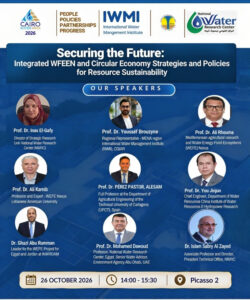
he National Water Research Center (NWRC) is pleased to invite you to a session organized by the NWRC, represented by its Strategic Research Unit and the International Institute for Water Management (IWMI), as part of Cairo Water Week 2026, entitled:
Securing the Future: Integrated WFEEN and Circular Economy Strategies and polices for Resource Sustainability. This session aims to transition the Water-Food-Energy-Ecosystem (WFFE) Nexus from strategy to action by addressing key challenges in resource sustainability and a circular water economy.
Joint efforts between the National Water Research Center and the Housing and Building National Research Center aim to update the Egyptian Code for Water Resources and Irrigation to tackle water scarcity and climate change challenges. Some of Expected Key Achievements & Developments: Hydraulic Structures Code: Updated design standards for regulators and weirs, incorporating dam safety guidelines, scour resistance, and seismic stability to ensure infrastructure longevity.
As water systems face increasing operational and sustainability challenges, digital transformation offers unprecedented opportunities to improve efficiency, reliability, and resilience. This session explores how Artificial Intelligence (AI), Internet of Things (IoT), and real-time monitoring technologies can support smarter water resources management and infrastructure operations in Egypt. Organized by the Mechanical and Electrical Research Institute (MERI) of the National Water Research Center (NWRC), the session will feature technical presentations on Intelligent Management of Pump Stations & Modern Irrigation , and Future Outlook for water infrastructure. The session will also feature a panel discussion entitled “Current Challenges Towards Operating and Maintaining Pump Stations Using Artificial Intelligence Tools” focusing on the key challenges and opportunities associated with adopting AI-based tools for more efficient, reliable, and sustainable pump station operation and maintenance.
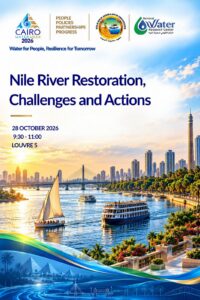
The Nile River is the backbone of Egypt’s water resources system, supporting water supply, navigation, and agriculture activities. However, the hydraulic performance of the river has been increasingly affected by sedimentation, channel instability, encroachments, changes in flow regimes, and climate variability. These pressures reduce river conveyance capacity, alter water levels and flow distribution, increase flood and inundation risks in vulnerable reaches, and affect the efficiency and safety of hydraulic structures and river operations.
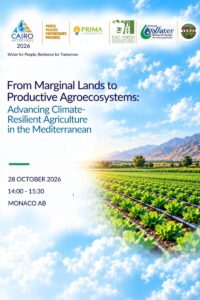
The session will provide a platform to discuss how marginal lands can be transformed into productive and climate-resilient agroecosystems through Neglected and Underutilized Species (NUS), with a particular focus on water efficiency, farmer benefits, socio-economic opportunities, business models, scaling, and policy support. The discussions and key messages emerging from the technical session will provide the basis for further developing the VENUS Open Day, where participants will be invited to explore the projects practical activities, field experiences, and research facilities at the National Water Research Center.
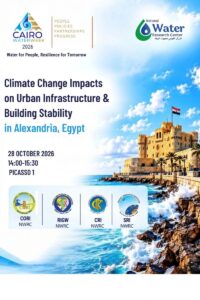
Alexandria, Egypt’s second-largest city and one of the oldest coastal metropolitan areas in the Mediterranean, faces increasing risks associated with climate change, rapid urbanization, aging infrastructure, and intensive coastal development. Sea level rise, more frequent storm surges, coastal erosion, saltwater intrusion, rising groundwater levels, and extreme rainfall events are placing unprecedented pressure on the city’s built environment. Recent observations indicate increasing occurrences of building distress, foundation deterioration, localized flooding, pavement failures, and degradation of coastal infrastructure. These challenges are interconnected and require an integrated multidisciplinary approach that combines coastal engineering, structural engineering, geotechnical engineering, hydrogeology, environmental sciences, urban planning, and disaster risk management. This workshop aims to establish a common scientific and technical platform for understanding these interacting processes and identifying practical adaptation strategies to improve the resilience of Alexandria’s urban infrastructure depending on actual data measurements.
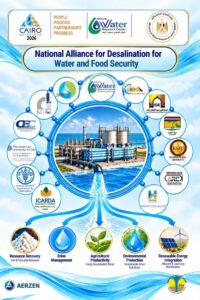
This session aims to define the roles of partners and stakeholders in advancing agricultural desalination in Egypt by addressing technical, financial, and institutional challenges. Specifically, the session focuses on the following practical objectives: • Review and establish clear goals, and specific expectations for the national alliance. • Assign institutional responsibilities and map the technical contributions of key national, and private partners within the roadmap development process. • Highlight practical pathways to integrate desalination within sustainable agriculture, ensuring optimal irrigation efficiency and cost-effective project prioritization. • Identify data and capacity limitations among local practitioners and water management authorities to establish targeted, long-term capacity-building initiatives.