
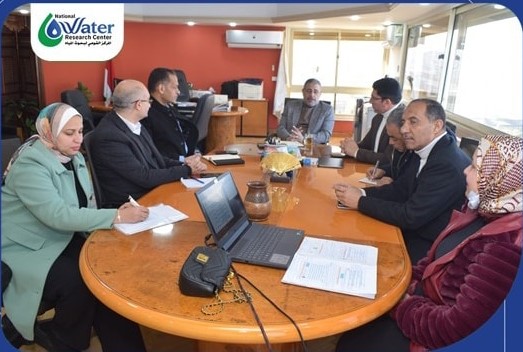
As part of the National Water Research Center’s commitment to monitoring and evaluating the research activities carried out by its affiliated institutes and units, Professor Dr. Sherif Mohamady, President of the Center, held a meeting on Saturday, January 17, 2026, with Dr. Mohamed Embaby, Director of the Water Management and Irrigation Methods Research Institute.
The meeting was attended by Professor Dr. Ayman El-Saadi, Vice President of the Center for the Research Plan; Dr. Mohamed Helmy, Director of the Institute’s Technical Office; Dr. Talaat Abu Zeid, Secretary General of the Institute; Professor Dr. Lobna Abdel Aziz; and Dr. Islam Sabry, Director of the Technical Office of the Center’s President, in the presence of Dr. Reham Farouk from the Technical Office of the Center’s President.
During the meeting, the research studies implemented by the Water Management and Irrigation Methods Research Institute during the first half of the 2025/2026 fiscal year were reviewed, within the framework of the approved research plan. The meeting also discussed the activities carried out at the Institute’s research stations, the consultancy studies, and the assignments implemented by the Institute on behalf of the Ministry. In addition, the current challenges facing the Institute were addressed, and proposed solutions to overcome them were discussed. Emphasis was placed on the importance of strengthening cooperation and integration between the Institute and the various sectors of the Ministry of Water Resources and Irrigation, as well as among the research institutes affiliated with the Center, in order to maximize the benefit from the outputs of applied research and studies.
The President of the Center stressed the necessity for research plan projects to have an executive and applied nature aligned with the Ministry’s strategies and directions, and to produce practical outputs and decision-support tools issued in the name of the National Water Research Center. He also emphasized the importance of maximizing scientific publications derived from these projects in peer-reviewed scientific journals.
In the same context, the President of the Center directed the need to maximize the utilization of available research capacities, physical models, and research stations, in a manner that enhances the role of the Institute.
This meeting comes within the framework of the National Water Research Center’s leadership’s keenness on closely monitoring all aspects of technical, research, and administrative performance, and reaffirming the vital role of research institutes in supporting the water resources management system and achieving its targeted objectives.