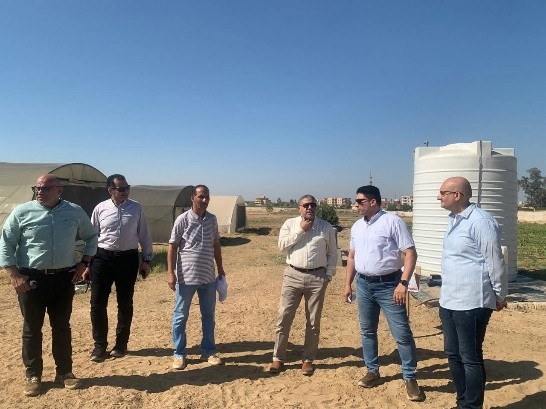
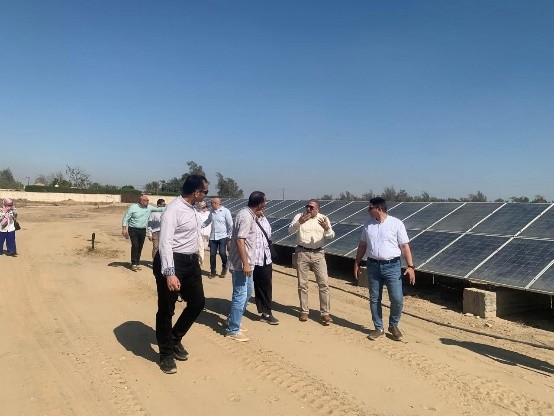
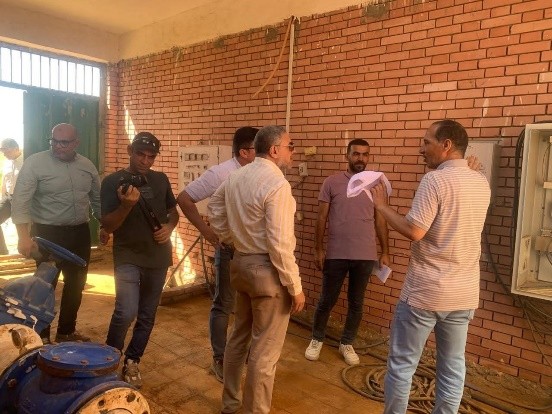
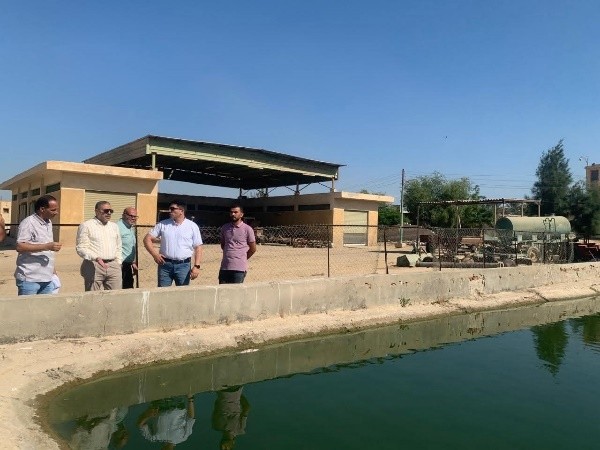
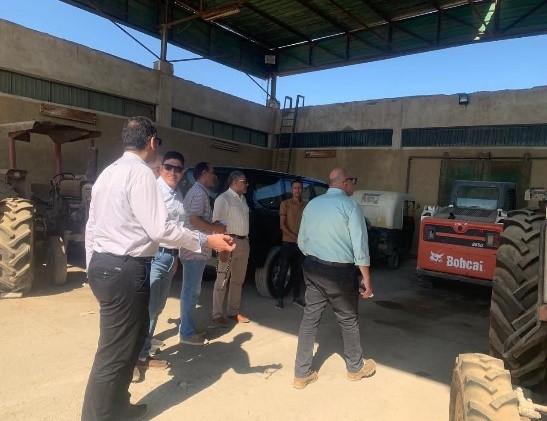
In light of the National Water Research Center (NWRC) leadership’s commitment to monitoring the progress of research projects funded in cooperation with international and regional entities, Prof. Dr. Sherif Mohamady — President of the NWRC — conducted a field visit on Tuesday, July 15, 2025, to the Wadi El-Natrun Research Station, affiliated with the Water Management and Irrigation Systems Research Institute, and to the study area being implemented as part of the project:
“Converting Marginal Lands of the Mediterranean Basin into Productive and Sustainable Agro-Ecosystems Using Low Water Demanding Neglected and Underutilized Species (VENUS)”
funded by the European Union’s PRIMA program.
Accompanying him during the visit were Prof. Dr. Aiman El-Saadi — Vice President of the NWRC for Research Plan Affairs, and Prof. Dr. Ahmed Hashad — Vice President for Research Staff Affairs. Also present were Prof. Dr. Alaa El-Din Abdeen — General Supervisor of Research and International Projects and Project Director, Dr. Islam Sabry — Director of the Technical Office of the NWRC’s President, Dr. Heba Kamal, and Prof. Dr. El-Sayed El-Bastamy from Technical Office of the NWRC’s President.
The delegation was received by Dr. Mohamed Embaby — Director of the Water Management Research Institute.
During the visit, Prof. Dr. Sherif Mohamady listened to a detailed presentation on the progress of the project to date. A number of neglected and underutilized species (NUS) available in Egypt have been cultivated as part of the project. These species are characterized by high tolerance to salinity and low irrigation water requirements, in addition to their promising economic return — most notably the prickly pear cactus.
It is worth noting that the VENUS project is being implemented in parallel across several Mediterranean countries, including Jordan, Algeria, Tunisia, Egypt, Greece, and Italy. It aims to make use of marginal lands by cultivating plants capable of withstanding harsh environmental conditions, thus contributing to economic returns while conserving water.
The NWRC President also inspected an experiment aimed at enhancing crop tolerance to saline irrigation water, which involves the use of algae to mitigate water salinity. This experiment is being conducted in cooperation between the Central Environmental Monitoring Laboratories and the Algae Biotechnology Unit at the National Research Centre. At the conclusion of the visit, Prof. Dr. Sherif Mohamady expressed his appreciation for the work and field experiments carried out so far, commending the efforts of the project team. He emphasized the importance of continuing the work with the same spirit and determination to ensure the project’s objectives are achieved as planned.